
Guilford County Criminal History Checks
Start with the record that can answer the question. The North Carolina eCourts Portal supplies public case summaries. Guilford County Clerk counters can provide the underlying paper file, free terminal access, or a certified single-county name search. The Guilford County Sheriff's Office P2C tools show recent bookings, current inmates, and incident entries. A fingerprint-based SBI Right to Review is the official route for reviewing your own North Carolina repository record. NCDAC covers public prison and community-supervision information, not pretrial custody in Guilford County.
Gather the full name, spelling variants, an approximate filing or arrest date, and any case or event number before searching. A birth date can help distinguish common names where the system permits it, but a name match alone never proves identity. Then follow the record to the office that owns the next stage.
- Search eCourts for a filed criminal case and limit the location to Guilford County.
- Check GCSO Recent Arrests and Inmate Search when the event is new or custody is the main issue.
- Record the case, event, or booking number and compare the listed charge with the correct person.
- Ask the arresting agency for public report facts and the clerk for the filed charge and disposition.
- Use a certified clerk search or your own SBI Right to Review when an official product is needed.
Record flow: Incident or arrest › booking and fingerprints › magistrate and prosecutor review › court case › disposition reported to state systems.
Search Guilford County Court Records
eCourts Smart Search is the broad starting point for public Guilford County criminal case records. Enter a party name or case number, open Advanced Filtering Options, choose Guilford as the location, and narrow the category to Criminal Actions when helpful. Current Enterprise Justice numbers use a two-digit year, the letters CR, a six-digit sequence, and a county identifier. Guilford's current identifier is 400. Older files and location codes may differ, so a no-result does not end the search.
The official Portal training resources explain wildcard rules. A partial case number needs at least four characters before an asterisk. A name wildcard needs at least three letters of the last name and one of the first name. Portal can show a register of actions, charges, events, hearings, dispositions, and public financial entries. It is not a certified record, and an event label is not always the final outcome.
| Portal field | Use in a Guilford search | Limit |
|---|---|---|
| Smart Search | Party name or case number | Main criterion is required |
| Location | Select Guilford County | Leaving it blank can return statewide results |
| Case Category | Choose Criminal Actions | Case types vary by category |
| Status | Narrow active or disposed cases | Disposed does not always mean convicted |
| Filing Date | Set a date range | Use the filing date, not just arrest date |
The live eCourts interface shows how one search can move from a name to the filed Guilford County case.
Official Background Checks in North Carolina
North Carolina does not offer a general-public SBI name-search portal. The North Carolina State Bureau of Investigation, Criminal Information and Identification Section, instead offers a fingerprint-based Right to Review for a person seeking their own state record. The request costs $14 and travels by U.S. mail. It covers fingerprint-supported North Carolina arrests and associated dispositions received by SBI, not federal or other-state files.
GCSO takes fingerprints by appointment at 401 W. Sycamore Street in Greensboro on Mondays and Thursdays from 8 a.m. to 5 p.m. The local charge is $10. Bring valid photo identification and an FD-258 card, then mail the completed card, request form, and certified check or money order to the SBI Applicant Unit at 3320 Garner Road, Raleigh, NC 27610. The SBI personal review instructions stress that results are mailed only to the subject.
For another person's public Guilford County court history, the official product is the Clerk's $25 certified, single-county search using AOC-CR-314. Courthouse terminals provide free inspection and email access to public court data. These products have different scopes.
| Official channel | Scope | Fee |
|---|---|---|
| SBI Right to Review | Your fingerprint-supported North Carolina history | $14 plus fingerprint fee |
| Guilford Clerk certified search | Public Guilford County court records by name | $25 |
| Courthouse terminal | Public court records statewide or by county | Free to view or email |
| FBI Identity History Summary | Your federal identity-history record | $18 direct electronic request |
The SBI service page provides the current self-review route.
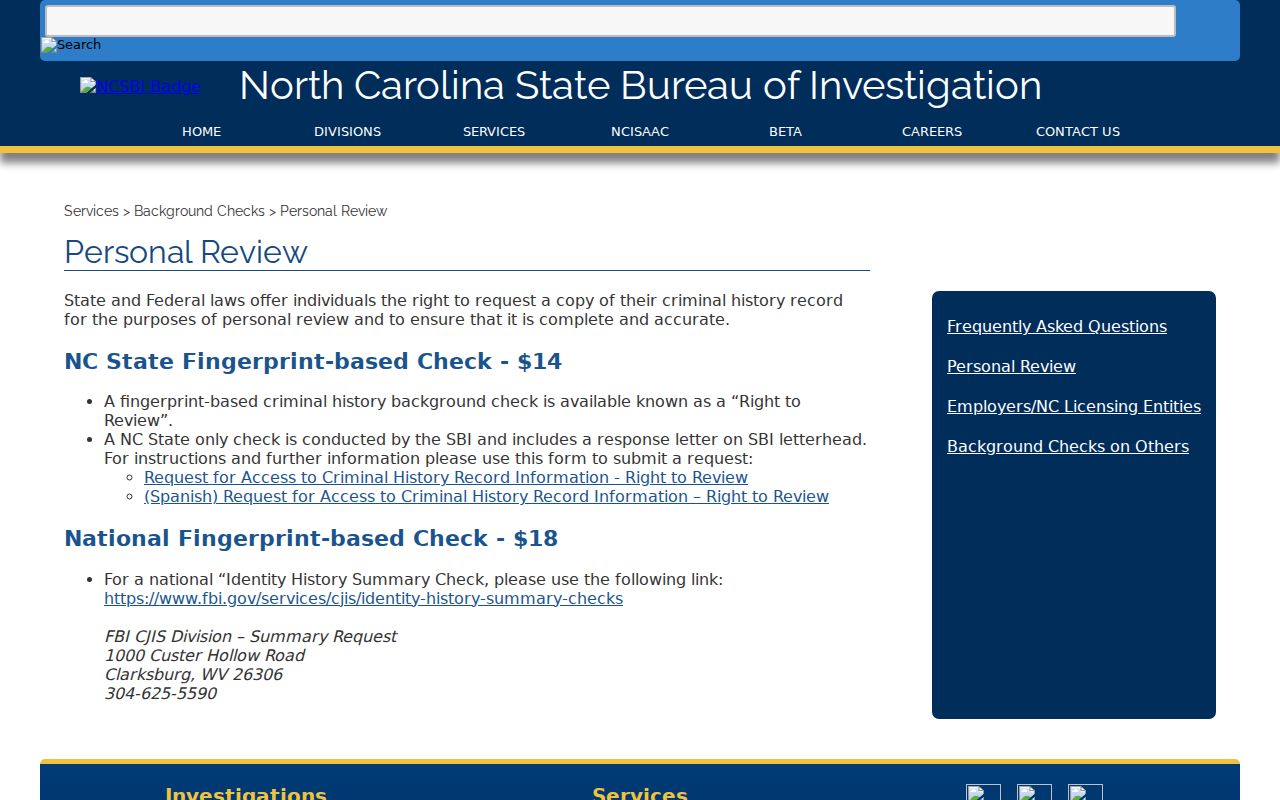
That page separates personal state review from the public Guilford County clerk search and from federal records.
Guilford County Courthouse Record Split
Guilford County maintains two full courthouse locations. Greensboro-side files are handled at 201 S. Eugene Street. The High Point division works from 505 E. Green Drive. Both house Clerk of Superior Court counters and support Superior and District Court sessions. A requester should identify the filing division before calling for a paper file because case numbers and older systems may preserve a Greensboro or High Point location indicator.
Both clerk offices are open weekdays from 8:30 a.m. to 5 p.m. and close from 12:45 to 1:45 p.m. Greensboro's main and clerk number is 336-412-7300. High Point's is 336-822-6700. Exterior drop boxes remain available around the clock, but they accept filings. They do not run a records search or produce a certified history.
Greensboro Clerk
201 S. Eugene St.
Greensboro, NC 27401
336-412-7300
High Point Clerk
505 E. Green Dr.
High Point, NC 27262
336-822-6700
Kinds of Criminal Records
A Guilford County criminal history is not one document. Police and sheriff offices make incident and arrest reports. Detention staff create booking records. Magistrates and prosecutors shape the charging path. The Clerk maintains the court file. SBI links fingerprint-supported arrest cycles with dispositions it receives, while NCDAC tracks prison and community supervision. Each source answers a narrower question and can update on its own timetable.
- Incident report: public facts about a reported event from the investigating agency, with sensitive investigative detail often withheld.
- Arrest and booking record: custody, intake charges, bond, facility, and release data from the arresting agency and GCSO.
- Court case file: filed charges, events, hearings, disposition, judgment, sentence, and public financial entries from the clerk.
- SBI criminal history: fingerprint-linked North Carolina arrest cycles and reported outcomes available through personal review.
- Custody or supervision record: county jail data from GCSO and public prison, probation, parole, or post-release data from NCDAC.
Juvenile, sealed, expunged, victim-identifying, medical, and unreturned-warrant material may not appear in an ordinary public search.
Guilford County P2C Record Channels
The Guilford County Sheriff's Office divides public online access among several tools. Inmate Search addresses current custody. Recent Arrests shows a booking slice, while Event Search addresses public incident entries. NextRequest is the fallback for an existing GCSO or county record that those tools do not expose. None of these replaces the clerk's case file or the SBI repository.
The GCSO home page routes readers to these official channels.
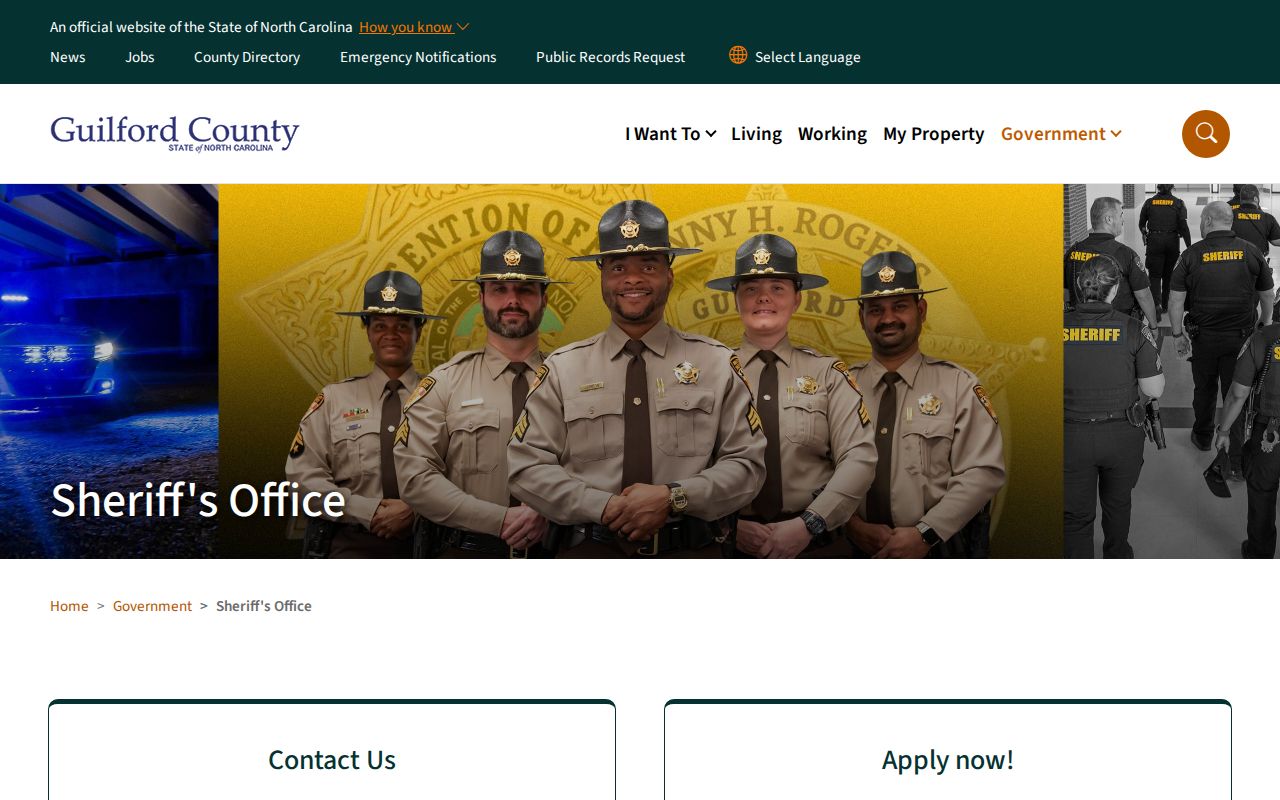
Its service links show why the record type must be chosen before entering a name.
The GCSO Event Search provides the direct incident-search form.
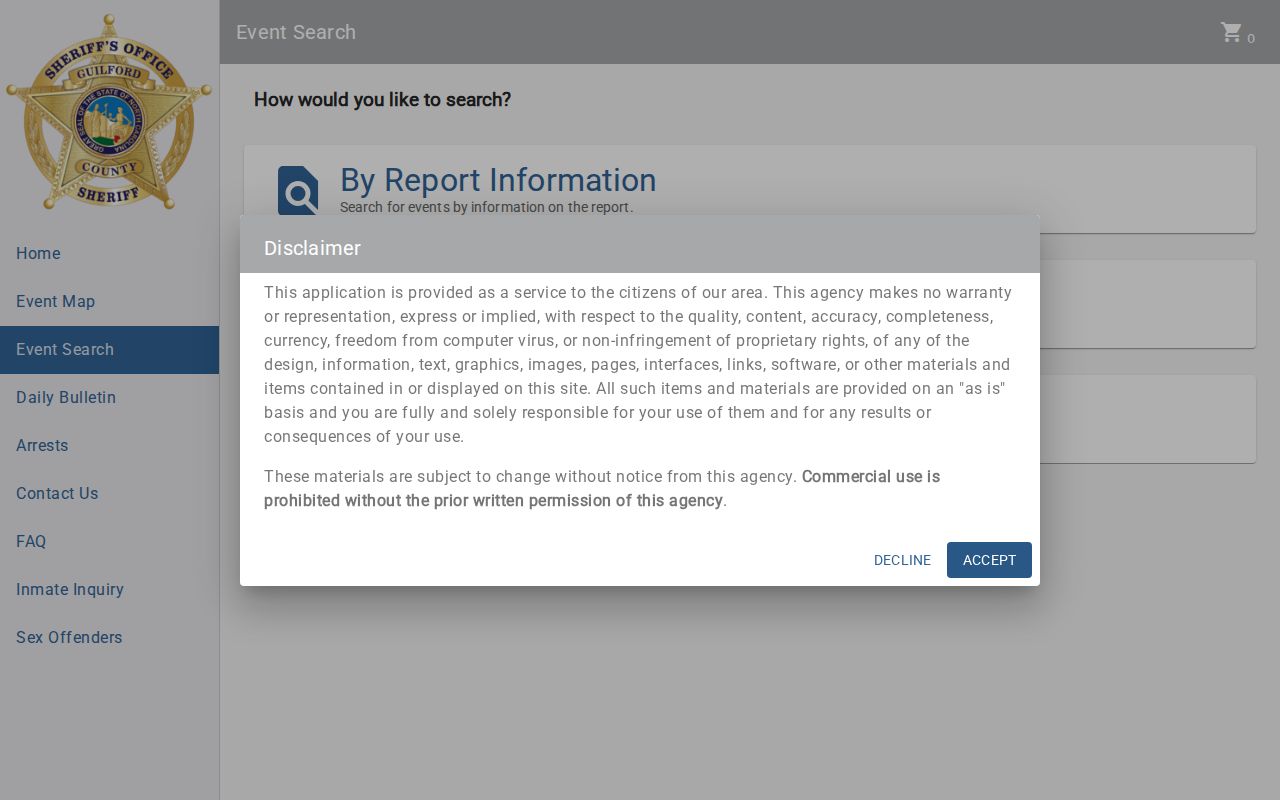
An incident result documents reported law-enforcement activity, not a conviction or full investigative file.
Guilford County Criminal Records: What They Contain
Fields change with the custodian. A booking card may identify the booking agency, arrest date, facility, intake charge, bond, release information, and a scheduled court date. A court file adds the case number, filed charge, counsel, event history, hearings, disposition, judgment, sentence, and public financial entries. SBI focuses on identity and fingerprint-linked arrest cycles with the associated dispositions it received.
Read status words in context. "Pending" means no final outcome has been entered. "Disposed" means an outcome exists, but it does not by itself mean conviction. Likewise, custody status says whether someone is held or released, not whether the filed charge was proved.
| Name and identifiers | Names, aliases, and permitted identity details used to distinguish the subject. |
|---|---|
| Arrest and booking | Agency, date, location, booking event, custody site, bond, and release fields where public. |
| Charges | Intake allegations or filed offenses, which may not match across systems. |
| Disposition | The charge-level result, such as dismissal, not guilty, plea, or conviction. |
| Sentence | Judgment terms, costs, custody, probation, or other court-ordered consequences. |
| Custody and supervision | Current jail status or public NCDAC prison and community-supervision data. |
- Disposition
- The outcome entered for a charge or case.
- Nolle prosequi
- A prosecutor's formal choice not to proceed, which is not a conviction.
- Arraignment
- The stage when the charge is formally presented and a plea is addressed.
- Expunction
- North Carolina's statutory process for removing qualifying entries from ordinary public access.
Guilford County Warrant Record Gaps
No verified public GCSO criminal-warrant name database exists. The county's Civil Process Search is not a criminal warrant search, and North Carolina eWarrants is restricted to justice users. Returned warrants generally become public court records unless sealed. Unreturned process may remain hidden from the ordinary eCourts Portal view.
For a Guilford County warrant question, call GCSO Warrant or Legal Process at 336-641-3735 in Greensboro or 336-641-7907 in High Point. The corresponding clerk numbers are 336-412-7300 and 336-822-6700. Magistrates can be reached at 336-412-7870 or 336-822-6719. GCSO Staff Duty handles nights and weekends at 336-641-3355. A person seeking to resolve their own warrant should obtain case-specific directions before appearing and should not assume a bond amount, surrender site, or real-time clearance.
Active process: Portal absence does not prove that no warrant exists. Confirm status and next steps with the issuing court or GCSO.
North Carolina Public Access Laws
North Carolina law opens many Guilford County records while assigning different limits to court files, law-enforcement material, and SBI history. The fastest route is the actual custodian. A county NextRequest submission cannot force the state court system to produce a case document, and the clerk cannot supply an agency's full investigative file.
Key North Carolina statutes:
G.S. 132-1 broadly defines public records unless another law creates an exception.
G.S. 132-6 provides inspection and copying at reasonable times under reasonable supervision.
G.S. 132-1.4 opens specified incident and arrest facts but protects much investigative material.
G.S. 7A-109 opens clerk-maintained criminal actions, judgments, and indexes unless access is restricted.
G.S. 114-19 controls dissemination of SBI criminal-history information.
Public access still does not prove accuracy or identity. Compare common names with reliable case identifiers and verify a result through the originating Guilford County office.
Guilford County Jail Records by Facility
GCSO operates two detention centers that together handle roughly 19,000 bookings each year and average more than 800 inmates. The Greensboro Detention Center opened in 2012 with a rated capacity of 1,032. High Point's 274-bed facility opened in 1990 as North Carolina's first New Generation direct-supervision jail. Transfers occur, so the city of arrest does not establish the current location.
Begin with P2C Inmate Search, then call the Greensboro jail at 336-641-2700 or the High Point jail at 336-641-7900 if a search fails. NextRequest can address unseen public booking data. The NCDAC locator is the correct statewide tool after a person enters state prison or public community supervision.
The NCDAC Offender Public Information Search demonstrates that separate state layer.
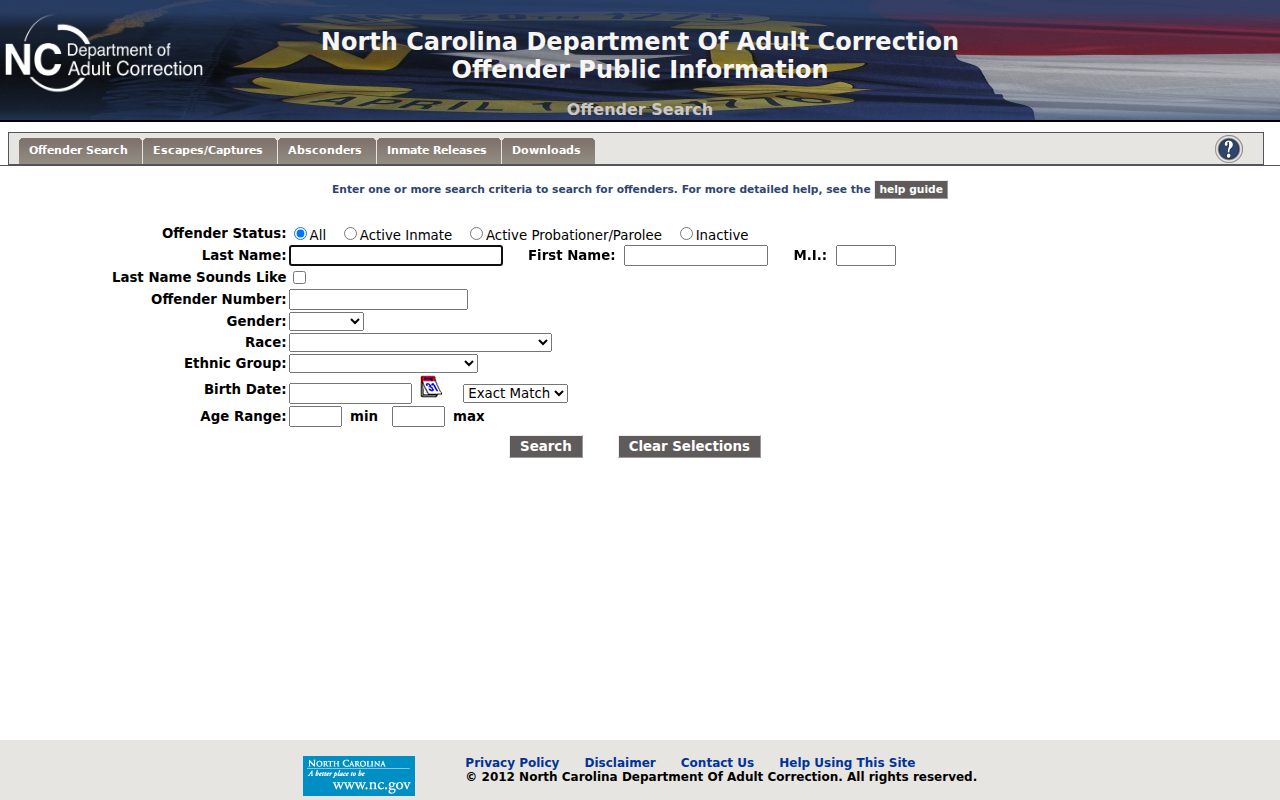
NCDAC results should not be used to infer current custody in either Guilford County detention center.
Restricted, Sealed & Expunged Records
Juvenile cases, sealed files, expunged records, unreturned warrants, protected victim details, medical material, and sensitive investigative information can be absent or redacted. North Carolina uses the term expunction. A petition is filed with the Clerk in the county of the charge or conviction and, in Guilford County, the correct Greensboro or High Point division.
Common routes cover qualifying dismissed or not-guilty charges, certain youthful matters, mistaken identity, and eligible nonviolent convictions. The usual petition fee is $175, though some dismissal or not-guilty routes carry no fee and an indigency waiver may apply. Qualifying all-dismissed or not-guilty dispositions entered on or after December 1, 2021 may be expunged by operation of law after the statutory period, but the event should be verified rather than assumed.
An order goes to named North Carolina agencies, not every private or out-of-state database. An arresting agency may also retain an investigative record as allowed by law. Preserve a certified copy of the signed order and check the responsible custodian if an official public source still displays the entry.
Correcting Guilford County Criminal Records
Choose the correction route by source. A wrong court event or disposition belongs with the Guilford County Clerk. A public booking or incident error begins with GCSO or the agency that created it. If your SBI Right to Review omits a disposition or contains a mismatched arrest, use the packet's Written Exception process. SBI CIIS audits the entry with the reporting agency.
The record chain can break when SBI never receives a fingerprint card, when a charge changes after booking, or when a disposition is not reported or matched. That is why a P2C card, live court case, and rap sheet can differ without any one of them describing the same stage incorrectly. Save case numbers, copies, and correspondence before asking for review.
The Guilford County NextRequest portal is the county's formal request path for existing records not available in P2C.
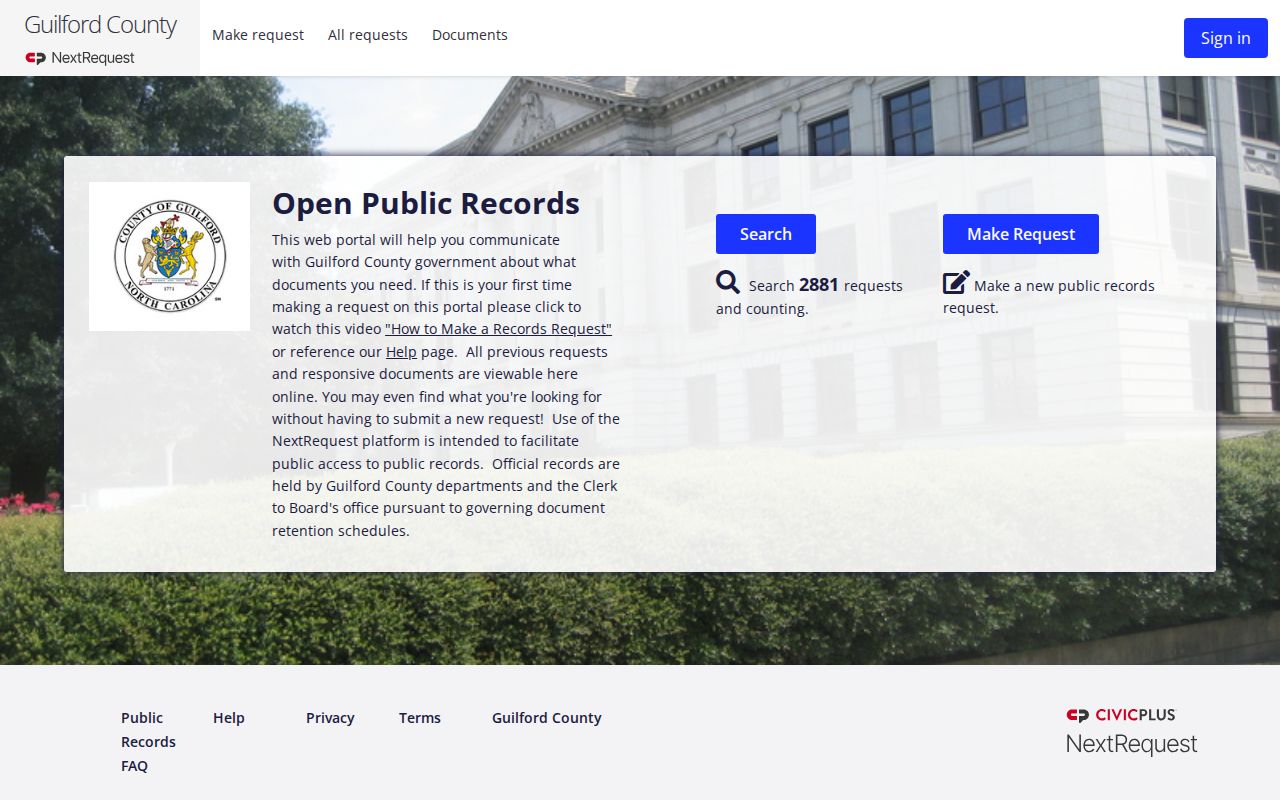
A clear request should identify the event, agency, date range, location, known number, and desired format without asking the county to create a new compilation.
Guilford County Mental Health Court Records
Guilford Mental Health Court began in 2007 and remains an operational North Carolina mental-health court. It serves eligible nonviolent repeat defendants with mental-health, substance-use, or co-occurring needs. District Attorney review includes public-safety screening. County Court Services also performs first-appearance screening, verification, release monitoring, aging-case review, and referrals to recovery and reentry programs.
The program is a local case-management path, not a separate public database. Its presence explains why a docket alone may not show every support, screening, or monitoring step around a Guilford County criminal case. The clerk file remains the source for public charges and dispositions, while program staff and protected records remain subject to their own access limits.
City-by-City Criminal Records in Guilford County
City and sheriff agencies create their own incident and arrest reports, but North Carolina's unified court system means Guilford County has no independent municipal courts. Greensboro and High Point matters proceed through state District or Superior Court, and Summerfield relies on GCSO for law enforcement. These city record checks stay focused on the correct local report counter before routing booking and case questions to county offices.
High Point also spans four counties, so its city name alone does not establish that Guilford County holds the case. Read the county identifier and courthouse location. In Summerfield, Town Hall is not the arrest-record counter; GCSO District 1 receives local report questions.
Greensboro Record Check
306,749 residents · GPD reports, P2C, and the Greensboro courthouse division.
High Point Record Check
117,674 residents · HPPD records, P2C, and the High Point courthouse division.
Summerfield Record Check
11,204 residents · GCSO District 1 reports and Guilford state courts.